


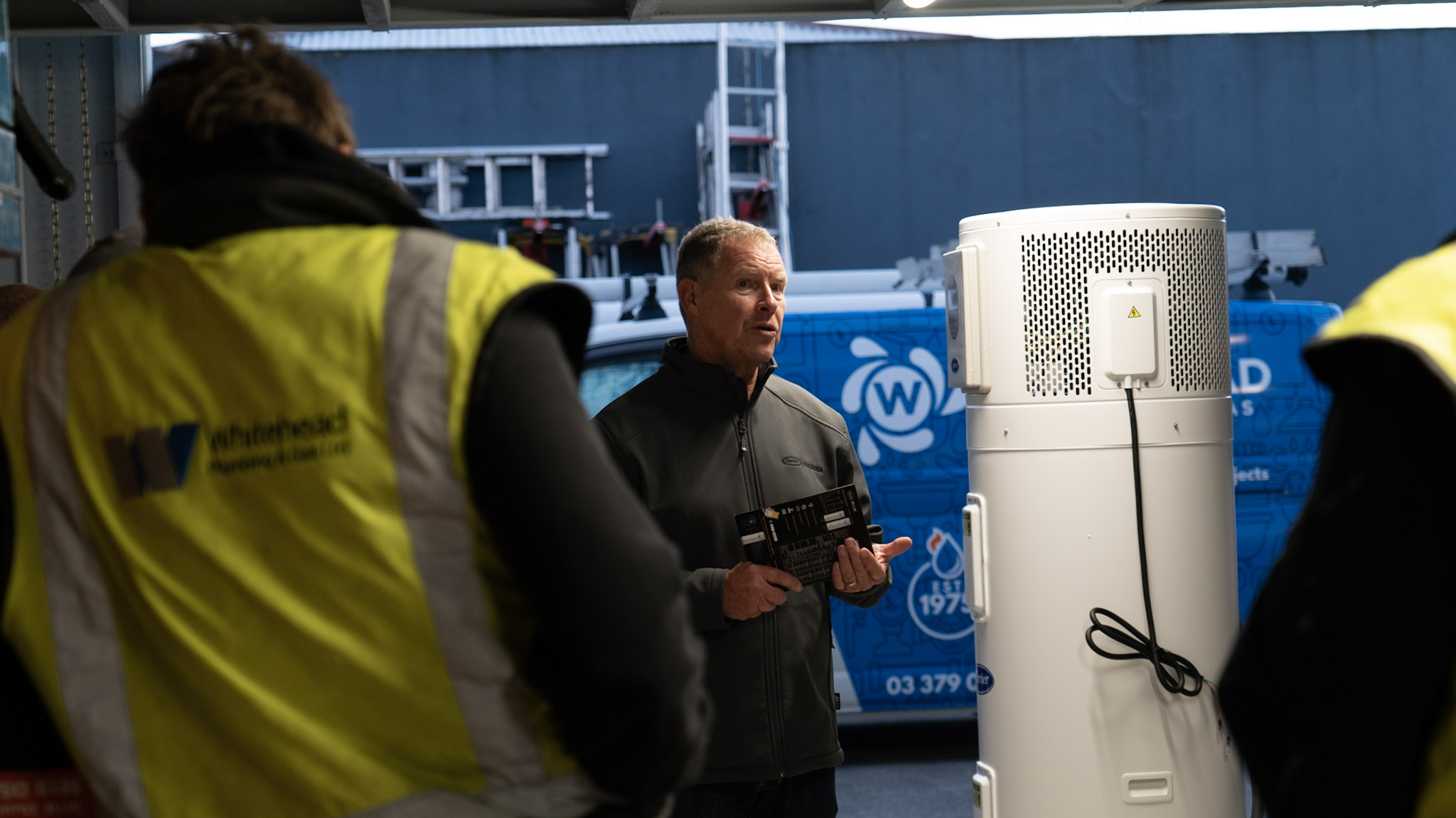
A full heat pump hot water cylinder weighs close to 400kg, about five adults standing on a single paving slab, every day, for the 10 to 15 years it’s in service. Moving your cylinder outdoors frees up the cupboard it used to live in, but it also raises a question most people don’t think about until we ask it on site: what’s it going to sit on?
Get the base wrong and the cylinder slowly tilts, the pipework takes the strain, and water ends up pooling where it shouldn’t. Here’s what the numbers say, what the Building Code requires, and how to work out whether a paver will do or you need a poured pad.
How much does a heat pump cylinder actually weigh?
More than most people expect, because the water inside makes up most of the load, roughly a kilogram per litre.
- Rheem AmbiPower 280e (280L): 132–135kg empty, 402kg full
- Rinnai HydraHeat Integrated 275L: 114kg empty, approx. 388–400kg full
- Rinnai HydraHeat Integrated 340L: 128kg empty, approx. 465–477kg full
So a typical 275–280 litre unit puts about 400kg onto a footprint roughly 700mm across.
Why these need a steadier base than an old-style cylinder
The heat pump unit sits on top of the tank, which makes the whole thing top-heavy, Rheem’s own installation instructions say the unit becomes unstable if it tilts more than 30 degrees off vertical. Rinnai’s heat pump head alone weighs 36.4kg.
There’s also the pipework to consider. The cylinder connects to your home via rigid hot and cold lines, so if the ground underneath sinks or tilts even slightly over time, that movement transfers straight into the pipe joints. It’s one of the ways a base problem quietly turns into a leak, something we cover in our guide, ‘Signs of a Leaking Hot Water Cylinder’.
What the Building Code actually requires
There’s no line in the Building Code saying “outdoor cylinders must sit on poured concrete.” Instead, it sets performance requirements, and the manufacturer instructions spell out what meeting them looks like.
Seismic restraint (Clause B1)
Storage water heaters need to be adequately supported against earthquake forces, the goal is to stop the tank toppling, moving away from the wall, or sliding along it. BRANZ’s guidance on seismic restraint of storage water heaters points to G12/AS1 (paragraph 6.11.4, Figure 14), which requires:
- 25 x 1mm galvanised steel straps, tensioned and fixed into the wall framing with 8mm coach screws penetrating at least 50mm
- 50 x 50mm timber blocking on either side of the tank’s closest point to the wall, to stop it rocking
- A third strap at the centre of the tank for cylinders over 200 litres
BRANZ notes that G12/AS1 covers tanks up to 360 litres in light timber-framed construction, integrated heat pump models may need different strapping because their weight sits unevenly. In line with this, Rheem specifies three seismic straps plus vertical blocking for the AmbiPower 280e, and Rinnai’s HydraHeat installation guide lists G12/AS1 Figure 14 and the AS/NZS 3500.4 seismic restraint method as acceptable.
Worth being clear on: seismic straps stop the cylinder toppling or sliding in an earthquake. They don’t stop a base that’s slowly sinking, you need both a sound base and correct restraint.
Water supply and drainage (Clause G12, AS/NZS 3500.4)
Both manufacturers require a level, stable, water-impervious base that won’t let water pond:
- Rinnai: the unit shouldn’t stand on a permanently wet surface. Condensate should be plumbed to a drain and gully trap rather than left to run onto the base, and relief valve discharge shouldn’t hit the base either, repeated water discharge can affect the cylinder over time.
- Rheem: the unit must stand upright on a level, stable and impervious base designed to avoid ponding, in line with AS/NZS 3500.4.
Option 1: A concrete paver on a prepared base
For most Christchurch homes, a heavy-duty concrete paver on a properly prepared base is what we supply as standard. Rinnai’s base design guidance lists a 600 x 600 x 40mm slab, laid on a level, compacted, well-drained base, as a suitable example.
The two words that matter are “compacted” and “well-drained.” A paver dropped straight onto lawn or loose soil will settle unevenly through a wet Canterbury winter. Done properly:
- Topsoil and organic material come out down to firm ground
- The base is compacted, levelled and usually bedded
- The paver is bedded firmly and checked with a level both ways
- The position allows for manufacturer clearances and condensate drainage
On flat, firm, free-draining ground, a well-laid paver is compliant, cost-effective, and does the job for the long haul.
Option 2: A poured concrete pad
Costs more, but it’s the right call on some sites. Rinnai’s base design guidance gives a 750 x 750mm pad, at least 75mm thick, on a firm, level, compacted base as one design concept.
We’d generally recommend a pad when:
- The ground slopes or is uneven: boxing out and pouring is the most reliable way to get a truly level surface on a gradient
- Water collects there: a pad can lift the cylinder clear of surface water; both manufacturers are explicit the unit shouldn’t sit on ponding or permanently wet ground
- The ground is soft: a pad spreads the 400kg load over a wider area than a single paver
- You want a tidier, longer-term finish: a pad sized to the unit’s clearances is neater and easier to keep clear of weeds
A poured pad is an additional $450 + GST on top of an outdoor installation, usually poured a few days ahead of the cylinder going in. This is indicative pricing for a standard job, your final quote depends on the site. See our hot water cylinder replacement cost guide for the full outdoor and heat pump pricing breakdown.
A detail most people miss: fresh concrete
Rheem’s installation instructions flag something easy to overlook, the cylinder shouldn’t sit directly on concrete less than two months old and not fully cured, because it can attack the metal coating on the base. Rheem recommends a moisture barrier between the two, extending at least 100mm beyond the cylinder, trimmed once the concrete’s cured. Since pads are often poured just days before install, it’s worth confirming with whoever’s doing the job.
Other base options
Rinnai’s base design sheet also shows 10–20mm gravel on a plastic reinforcement grid over a compacted, level base, and a timber deck on a solid frame with adequate load capacity and ventilation. A deck needs particular care, it has to carry ~400kg on a small footprint without flexing. Rinnai is clear its illustrations are design concepts only, not complete or compliant installations on their own, any base still needs to follow the installation manual and local requirements.
Clearance space around the base
A base sized only for the cylinder’s footprint can cause problems, since heat pump units need airflow and service access:
- Rheem AmbiPower 280e (minimums): 25mm behind, 350mm on the air inlet side, 600mm on the air outlet side (600mm front/sides and 650mm above recommended for servicing where possible)
- Rinnai HydraHeat: 400mm either side, 500mm above, 10mm from the wall
Rheem also recommends keeping the unit away from bedroom and living room windows, including neighbours’, since it makes some noise while running. Worth settling the position before anything’s laid or poured.
Paver or pad? Which does your home need?
Flat, firm, free-draining ground that can be properly prepared: a bedded concrete paver is usually all you need. Sloping, soft or wet ground, or a spot that collects surface water: a poured pad is the more reliable option long-term.
Either way, the base needs to be level, stable, impervious, and able to carry a full system without shifting, and the cylinder needs to be seismically restrained to the wall framing. A site visit is the only way to know for sure, which is why we look at the ground, drainage, slope and clearances first and tell you honestly whether the standard paver will do.
FAQs
Do I need a concrete pad for a heat pump hot water cylinder?
Not always. On firm, well-drained ground, a properly bedded paver usually meets the requirement for a level, stable, water-impervious base. A poured pad is recommended on sloping, soft or wet ground.
How much does a full heat pump hot water cylinder weigh?
Around 400kg for a 275–280 litre unit. Rheem lists the AmbiPower 280e at 402kg full; Rinnai lists its 275L HydraHeat at approximately 388–400kg full.
How big should a concrete pad be?
Rinnai’s guidance gives 750 x 750mm, at least 75mm thick, on a firm, level, compacted base as one example, though the right size also depends on clearance and service access.
What does the Building Code say about outdoor hot water cylinders?
Clause B1 requires storage water heaters to be supported against earthquake forces, with G12/AS1 (paragraph 6.11.4, Figure 14) setting out an acceptable strapping method. Manufacturers also require a level, stable, impervious base designed to avoid ponding, per AS/NZS 3500.4.
Can a heat pump cylinder go straight onto new concrete?
Rheem advises against direct contact with concrete less than two months old, since uncured concrete can attack the base’s metal coating. It recommends a moisture barrier extending at least 100mm past the cylinder.
How much does a concrete pad cost with Whitehead?
An additional $450 + GST on an outdoor cylinder installation, usually poured a few days ahead of install. A concrete paver is included as standard. Pricing is indicative and depends on a site assessment.
Book a site visit
We install heat pump and outdoor hot water cylinders across Canterbury, including the Rheem AmbiPower 280e and Rinnai HydraHeat. We’ll assess the ground, recommend the right base, restrain the cylinder properly, and tell you upfront whether you actually need a pad. Give us a call on 03 379 0711 to book a site visit, or check our rates first.
This article is general guidance based on manufacturer installation documents, BRANZ and MBIE information available at the time of writing (September 2026). Building Code requirements and product specifications change, and every site is different, always follow the current manufacturer instructions and get advice from a registered plumber for your specific installation.